One file to rule them all — how linked open data can rewire the maker map?
“I have connections with Venice … I don’t know if the University fab lab is still open though.” — VULCA Members group, April 2026
Read that again. Someone in a 200+ members network of makers, who personally knows the space they’re talking about, has no way to check if it’s still open. This isn’t a question about effort or connections. It’s a question about freshness. And no map in the ecosystem currently answers it.
Sound familiar?
Every maker network has a group chat. And every group chat showcase the same recurring questions:
- “I’m going to be in Bath for a few days, does anyone know labs I could visit?”
- “Our Fablab is looking for a space to learn metalwork and welding — we have an Erasmus+ grant.”
- “Any contacts near Barcelona? I’ll be there next week.”
- “Looking for hosting organizations for an Erasmus+ mobility project — IoT and art focus.”
These are not small talk. These are real, urgent, practical needs. We ran the numbers on one VULCA’s group chat over four years — 1,072 messages. The same clusters appear again and again. Grant and consortium partner search is by far the loudest need. Residency brokering follows close behind. Finding a space to visit, checking if a space is still active — these too.
The questions are predictable. And look at what they all have in common: location, location, location. Where to go. Who to reach near that place. Whether a space still exists on a map somewhere. Even when a friend answers, the answer points back to a place — a website, a pin, a contact tied to an address. The map is actually the natural move to answer those. It isn’t. So we ask 200 people instead.
Horizontal bar chart of recurring question types in a European maker network group chat, 2022–2026. Teal bars are answerable with a minimal space endpoint today. Amber bars require richer schema and represent the biggest unmet needs.
Amber bars — 48 of 89 occurrences — represent questions no map answers today, even a perfectly fresh one.
Consortium matchmaking alone accounts for 26% of all recurring requests.
Hand-counted from one VULCA chat export, 2022–2026 · 1,072 messages.
Nobody trusts the maps
There are 15+ directories listing makerspaces, fablabs, hackerspaces, open workshops, and biolabs — European networks, global ones, national initiatives, thematic ones like the Open Flexure Network or GIG. They all exist. Most of us know they exist.
And yet — we still post in the group chat.
Because we’ve all been burned. You find a space on a map, you reach out, you get no reply or a bounce. You show up, the door is locked. The hours are wrong. The laser cutter listed hasn’t been fixed for two years. The space itself closed in 2021.
Fifteen directories. The same intuition — make the maker ecosystem legible — built the same way, hitting the same wall. Every one of them asked spaces to come to them: register, create an account, fill a profile. And spaces did. Because there’s something real in that act. A new fab lab registers on fablabs.io the same way it sets up a website — not to maintain it, but to exist.
📣 Hey, look — we’re here. 🚩👋
That moment of registration is the whole reward.
But nobody goes back to update. There’s no incentive to — the presence is already claimed. And so the data drifts. The map freezes at the moment of signup. The laser cutter gets listed forever.
Meanwhile, each platform sends the same request to the same coordinator — log in, find the field, update it. Not urgent enough to act on. Not ignorable either. A non-priority urgency, arriving from everywhere at once. The kind of weight that doesn’t break anything visibly — until someone checks if the Venice fab lab is still open, and nobody knows.
So we stopped trusting the maps. Not consciously, not as a decision — it just happened. The WhatsApp group became the single source of… hope.
The flip: your data, your file
What if it worked the other way?
Instead of pushing your data to fifteen platforms, you publish one file — and give us the URL. That’s it. A small, structured file that says: here’s who we are, where we are, what we do, whether we’re open. It can live anywhere online.
Every map, every directory, every bot that cares about your space reads from you — not from a copy of a copy of a copy.
You update once. Everyone gets the fresh version. Automatically.
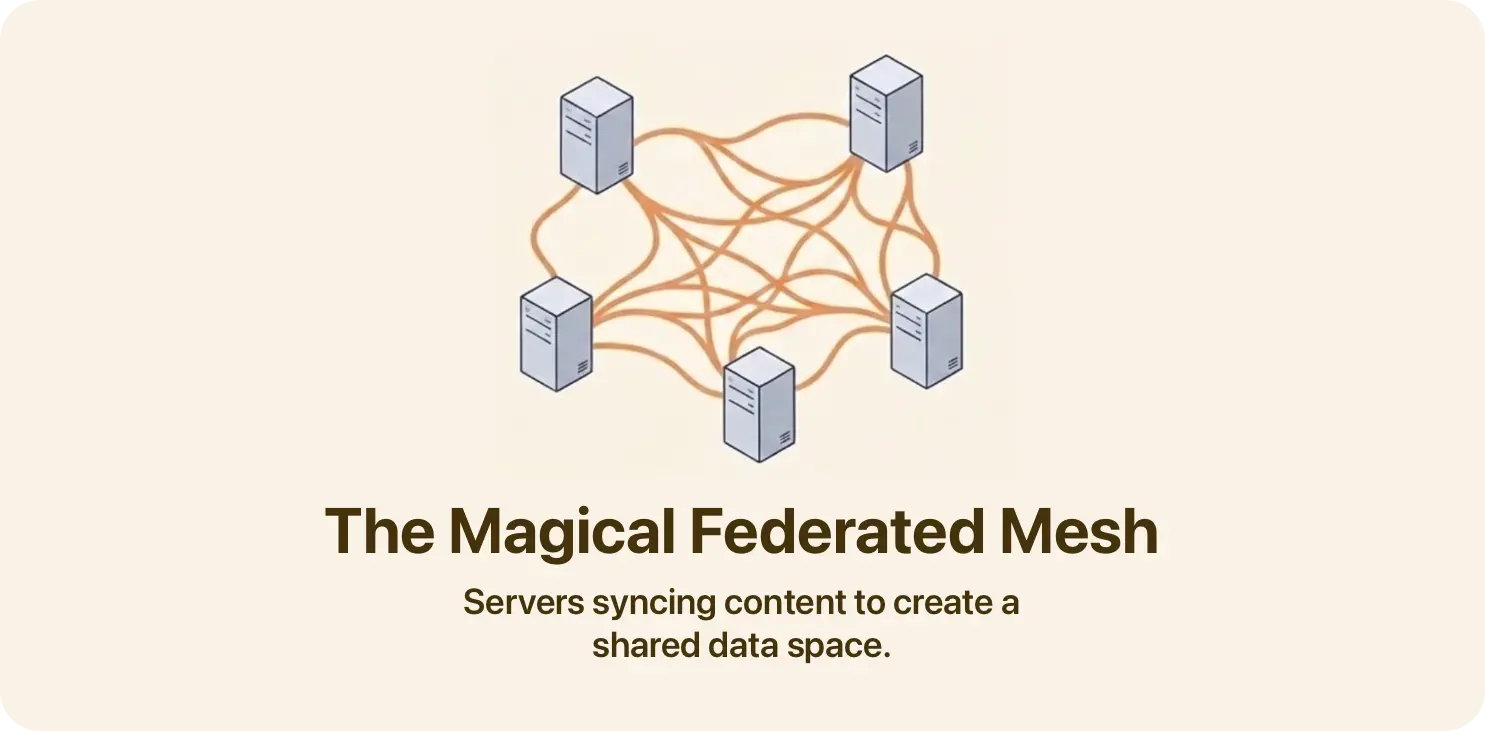
This is the exact same logic behind SpaceAPI, which hackerspace communities have been using for years. Hundreds of spaces, one simple endpoint per space. Works beautifully. We want to build on that spirit for the broader maker ecosystem.
What we’re asking right now
Concretely: a public URL pointing to a structured file about your space. Where it lives is up to you — your website, GitHub, Nextcloud, Google Drive, a VPS, whatever your stack already has. The only condition: the URL must be reachable without a login.
It looks something like this:
{
  "name": "FabLab of Ooo",
  "address": "12 Sugar Plum Street, Land of Ooo",
  "website": "https://fablab-of-ooo.example",
  "logo": "https://fablab-of-ooo.example/glob.png",
  "contact": {"email": "princess.bubblegum@fablab-of-ooo.example"},
  "state": {"open": true },
  "opening_hours": "Mon–Fri 14:00–20:00",
  "specialties": ["sovereingty", "electronics", "candy science"],
  "sdg": ["04", "09", "12", "17"],
  "network_memberof": ["VULCA", "Adventure Makers Network"]
}
That’s the minimum.
We’ll run online workshops with RFF (Réseau des Fablabs Français) and VOW (Verbund Offener Werkstätten) to walk through it together — no solo setup required.
What happens once we include your URL:
- Your flag on the map goes from ⚪ → 🔵 — confirmed by you, fresh
- You can embed a live map view directly on your own website
- Any change you make to your file reflects on the map immediately — no login, no form, no middleman
What this unlocks — progressively
Once enough spaces have a confirmed endpoint, the map stops being a static phonebook. It becomes something you can actually query.
Some questions are answerable from day one, with just the minimal file:
- “Show me all confirmed open spaces within 100km of Bath” → yes, from
status+ address geocoding - “Which spaces in Germany have woodworking?” → yes, from
specialties - “Who are the current members of VOW?” → yes, from
network_memberships
Others — finding spaces that have hosted Erasmus+ residencies, or knowing current machine availability — need richer fields. But “richer fields” undersells what’s actually happening.
When we agree on what specialties means — that “woodworking” and “wood shop” are the same thing, that “laser cutting” implies certain capabilities — we’re building a shared vocabulary. A small ontology. That’s what makes cross-network queries possible: not just more data, but data that means the same thing across RFF files and VOW files and spaces in Porto or Nairobi.
This isn’t new territory. The Internet of Production has been building exactly this kind of semantic layer for manufacturing — a shared language for production resources, processes, and supply chains. The maker community’s contribution is a vocabulary designed bottom-up, from the real questions that group chats have been asking for years. Which fields would have answered the most common questions? That’s the design method.
The minimal file is the seed. The ontology is what grows.
Imagine
A maker in Marseille logs into RFF Mattermost and posts in the #map-of-making channel: “J’ai envie de partir en long week-end à Berlin ou Hamburg, rencontrer des makers et filer un coup de main — quelqu’un connaît des espaces ouverts à ça?”
A bot reads the query. It cross-references RFF and VOW endpoints. Filters for spaces in Berlin and Hamburg with open_for_hosting: true. Finds three spaces. Posts back: names, contacts, a small map — with travel times from Marseille-Saint-Charles shown on each pin. Berlin: 12h. Hamburg: 15h30. The maker sees it, decides it’s worth it, and replies directly to one of the contacts.
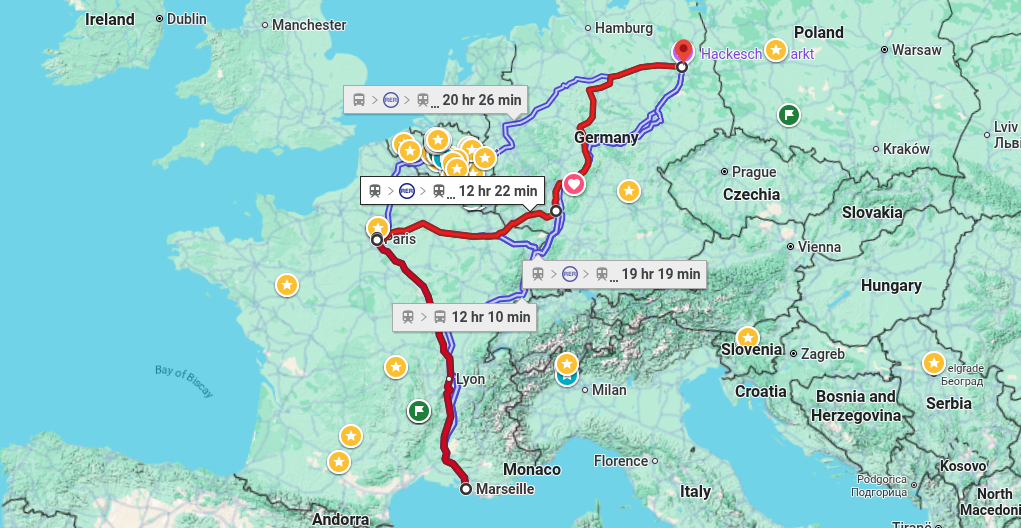
No new tab. No waiting for 200 people. The map comes to wherever you already talk.
And notice what didn’t happen: no hallucination, no scraped website, no stale PDF. Structured data, a spatial query, and a language model that turned a casual French message into a precise question — and a precise answer back into plain language. The model doesn’t need to be large. It just needs to know how to build the query.
That’s not science fiction. It’s a direct consequence of spaces publishing one structured, live, open file. And it’s where this is going.
What happens to the group chat
It doesn’t go away. It gets better.
Right now, the group chat is doing two jobs at once: it’s the warm, human connective tissue of a community and the fallback infrastructure for orphan questions. When the second job is handled, the first one has room to breathe.
Imagine the same channel, quieter on logistics — and open for the conversations that actually need humans. The weirder collaborations. The harder questions. The ideas that don’t fit a form field. The group chat was never the problem. It was the silent warning that the map infrastructure beneath it hadn’t arrived yet. Once it does, we get to find out what the community talks about when it stops asking “are you still open?”
Join us
We’re starting with two networks — RFF and VOW — as the first pilot. We want to learn fast, fail small, and build with you, not for you.
If you’re a space manager or network coordinator: the first workshops are coming soon through RFF and VOW channels. If you’re elsewhere in the world and want in, reach out — the model is designed to extend.
If you’re a developer or FLOSS enthusiast who wants to dig into the architecture — linked open data, federated endpoints, we design a full sovereignty stack to store personal documentation — this is the first in a series. The next articles go into the schema that unlocks consortium matching and residency brokering, then the individual maker layer and how data flows bottom-up based on consent. The repo will be public.
Maps of Making is a project by Nicolas de Barquin (Openfab, Brussels) and Jason Pettiaux, coordinated from Brussels with the moral support from 12 organizations across four continents — European networks (RFF France, HTT UK), individual spaces in Spain, Ireland, Croatia, Italy, and Portugal, researchers, and global networks representing spaces across Africa, Asia, and Latin America (FabCare, GIG, ReFFAO, Internet of Production).
This approach builds on SpaceAPI, W3C Linked Data, and Solid.