A fresh perspective on Open Value Networks
This is a proposal, not a finished thing. Nobody has signed anything. But for the first time in about a decade, I think the pieces to build an Open Value Network at a place like Syntonie and Superlab are finally in the same room — and I want to lay out why.
If “Open Value Network” means nothing to you yet, good. Let’s build the idea together, with analogies instead of theory. You can chase the keywords later — there are references at the bottom.
The mental model, in four pieces
1. Most makerspaces run like a gym.
You pay a subscription, you get access to the machines, you make your thing and go home. Value flows one way — from member to space. The laser cutter doesn’t care who you are, and the space doesn’t really get richer when you teach someone, fix a jig, or write up how you solved a problem. That work is invisible.
2. An Open Value Network (OVN) runs like an open-source project — for physical things.
Think of how open-source software works: anyone can contribute without asking permission, every commit is recorded, and what you put in is visible and credited.
An OVN applies that to a community of makers. People pool not just fees but skills, time, tools, and ideas; contribution is tracked; and value — including revenue — flows back to contributors in proportion to what they actually put in. It’s permissionless, judged on what you can do rather than your diploma, and you pick your own role. The proven example is Sensorica in Montreal, running since 2011 with real commercial revenue and thousands of logged contributions.1
3. The whole thing lives or dies on one hard problem: accounting the contribution.
Logging billable hours is easy. The hard part is the invisible contribution — the mentoring, the cleanup, the documentation, the social glue. Capturing that fairly, then structuring it into something you can actually compute a fair share from, is enormous manual labour. I borrow a term from blockchain for the function that has to pull this off — the value oracle — because putting a number on a fuzzy contribution always feels close to divination. This accounting wall is the reason a model that works has stayed rare and hard to join.
4. That wall is exactly the shape of what AI is now good at.
Parsing messy human input into structured records, summarising, translating, matchmaking, flagging anomalies — that’s the administrative cognition that scales badly with community size, and it’s precisely what LLM agents absorb well.
Not replacing human coordination — amplifying it.
One honest caveat, because it matters:
AI is good at sifting data, but it can’t sift data that was never captured.
The wall stands on a foundation — getting the contribution recorded at all — and that foundation is a human-habit problem before it’s a technical one. AI lowers the effort of recording, which is exactly what makes the habit installable. But it doesn’t remove the need for the habit.
Here’s the analogy that makes it click for me. Recording every contribution used to be like shooting on film — each frame cost something, so you only captured the big occasions and let the everyday slip by. The smartphone dropped the cost of a photo to near zero, and now we capture everything without thinking. AI does that to the bookkeeping of a commons: the ten-minute fix, the hallway mentoring, the cleanup nobody asked for — the work that was always too small to be worth logging finally costs almost nothing to record.
That’s the whole bet: the invisible-contribution accounting that made an OVN too costly to run is exactly the cost AI just collapsed.
Why I’ve carried this for a decade
I haven’t just watched this wall — I burned out on it. As a founder and fab manager of Openfab (one of Brussels’ first makerspaces, since 2012), I hit the invisible cost head-on, and I’ve since met plenty of peers who burned out on the same thing: the unpaid, unrecorded coordination work that holds a community together until it quietly breaks the person doing it.
In December 2016 we had the chance to invite Michel Bauwens to Openfab, and to meet Tiberius Brastaviceanu — in Brussels for the closing of P2Pvalue, the EU research project on commons-based peer production — who built Sensorica and much of the OVN model. That was the spark — the first time I saw the wall clearly enough to name it. It opened a decade-long arc of exploration: a few successes, mostly failures, all of them running into the same inevitable cognitive cost.
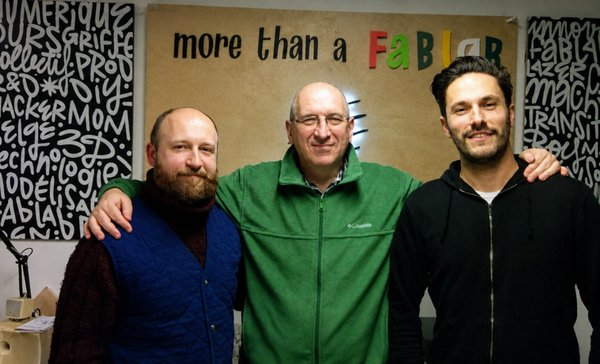
Michel Bauwens at Openfab Brussels — December 2016.
I won’t reconstruct conversations I only half-remember. What I took away is that the model genuinely worked for Sensorica — but onboarding anyone new was brutal, and the wall everyone hit was always the same: the manual cost of accounting for contribution.
But accounting was only half of what I carried. The other half is softer and harder: coordinating a fluid structure of volunteers is herding cats.
People come and go, attention drifts, and the work that holds a community together is the work nobody is assigned. You can’t command it. You can only make the path of least resistance line up with what each person already wants.
That’s why I spent years down a second rabbit hole — productivity tricks, habit formation, how you actually install a behaviour like documenting your own work. The honest answer is the one from the FOSDEM talk “The Selfish Contributor, Revisited”: people contribute to a commons when contributing also serves a selfish need. A community holds together when its common goal and its members’ private goals are aligned. The whole game is lowering the effort of the good habit until it’s cheaper to do than to skip — and that’s exactly the lever AI gives us.
So the quest had a name I only recognised later: documentation.
At FAB14 in 2018, a few of us landed on the shape of an answer — don’t centralize, federate; and don’t mandate documentation, grow a culture of it through positive incentives like skill-leveling and a portable “maker passport.”2
Then came years of trying to build it, mostly through game design. I’ll be honest: I never fully cleared either wall. People in flow won’t stop to document (the human-factor wall), and turning whatever is captured into something fair and queryable is exhausting (the value-oracle wall).
For a decade, those were my dealbreakers. My best guess for why peer production thrived in software and barely touched physical making.
What changed
The wall is still there. But this year, for the first time, I think I can see stairs.
The research I pulled together from latest OVN articles3 maps the highest-leverage AI roles almost one-to-one onto the walls I kept hitting:
- Contribution assistant — turn plain language (“spent 3h debugging the weather-station Arduino, ~50g PLA”) into a structured record. The context-switching wall, demolished: you speak your contribution instead of filling a form. The deeper shift here is moving from SQL-style rigid schemas — where you must speak the database’s language — to graph-friendly unstructured input where the LLM handles categorisation, structuring, and query translation on your behalf.
- Skill matchmaker — surface potential pairings between people and projects; highlight the match, never assign it. Self-selection stays the mechanism — the tool just makes the options visible. Adjacent to this: a skill pattern engine that reads the contribution log and notices emerging competencies before the person names them. Not a diploma handed down, but a skill tree grown bottom-up from evidence — practice recognised, not certified.
- Knowledge keeper — auto-document from chat and notes; keep the institutional memory that otherwise walks out the door. One principle I won’t bend on: never automatic, but automated. The system should document for you, but only when you consciously hand it something — think of a walkie-talkie’s push-to-talk button: pressing it is the consent to be recorded, and letting go means nothing is captured. I’m designing this layer around W3C Solid pods — giving each contributor sovereign control over their own data, with interoperability and access permissions baked in at the standard level, not bolted on.
- Governance facilitator — summarise threads, draft proposals, translate across French / Dutch / English (in Brussels, not optional). And help resolve decisions, not just document them — methods like quadratic voting become practical when the friction of running them drops to near zero.
- Value oracle — suggest distribution parameters, simulate “if we adopt this, Member A gets X€,” flag anomalies. Recommendations, never decisions — the equation still belongs to people. The use case I’m most interested in: dynamic equity — a model where shares adjust continuously as contributions accumulate, making it possible to onboard new contributors fairly into an ongoing project without a painful renegotiation every time someone joins.
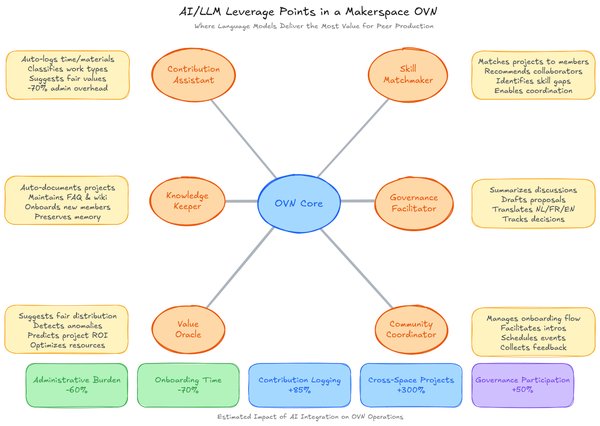
The report attaches optimistic numbers to these — on the order of a 60% cut in admin overhead, 70% faster onboarding. Those are the report’s estimates, not measurements I’ve made. And not all spaces are represented - sorry - but even discounted heavily, they point the same way.
Why Superlab, why now
Two things make this more than a thought experiment.
First, the proof already exists in Brussels, a tram ride away: Micro Factory runs 2,500 m² and >100 peoples on explicit p2p commons principles. Members already owe contribution hours, already self-manage in circles, already sit inside an ASBL-plus-community structure.4 That’s most of an OVN’s social architecture, working. The part it doesn’t have is the accounting layer — exactly the part AI now addresses.
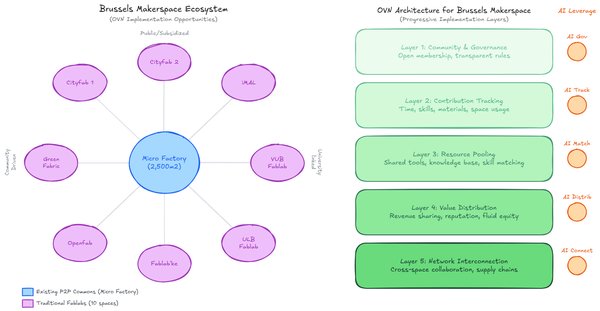
Second, the momentum is real and personal.
Jason, who builds Maps of Making with me, is now based at Superlab, with energy from inside to organise and reinforce the community. And Maps of Making already gives us the federated data layer — each space publishing from its own source. An OVN is the economic layer that sits on top: federation says where the spaces are and what they have; the value network says who contributed what, and what they’re owed.
Same federated spine, two layers, composable.
A roadmap, offered as a proposal
If Superlab wanted to try this, it doesn’t start with technology. It starts with people — the Sensorica lesson, learned the hard way: start with community, not the platform.
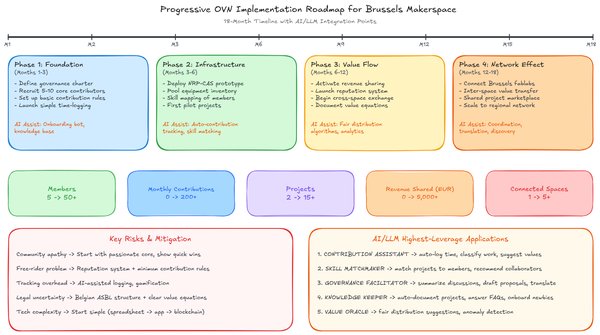
An 18-month shape:
- Foundation (months 1–3).
5–10 committed contributors draft a lightweight charter: contribution categories, decision-making, value-equation principles, custodian ASBL. Logging starts in a JSON on gitlab; an onboarding bot answers the charter questions. - Infrastructure (months 3–6).
Adapt existing open tools and vocabulary for contribution logging. Inventory skills and resources. Run 2–3 deliberately cross-disciplinary pilot projects. - Value flow (months 6–12).
The first benefit redistribution, however small — the single most convincing thing you can do. Reputation and governance facilitation come online. - Network effect (months 12–18).
Connect outward to the wider Fablabs Brussels network — inter-space contribution, a shared project marketplace — riding the Maps of Making federation underneath.
I want to be honest about the altitude: this is a proposal, not a program.
From my perspective, the human-factor wall is better-addressed by AI, not proven solved.
The first step is the only one that matters
Everything above is downstream of one small act: a few makers, in one space, deciding to try something different and agreeing to write down what they put in.
The model works — Micro Factory shows it works here. Maps of Making gives us the rails. AI finally makes the accounting humane. The wall is still a wall, but I can see handholds now. I think it’s time to climb.
Sensorica & the OVN model: OVN Wiki, Post-Blockchain and the Case of Sensorica (MDPI, 2020), P2P Foundation Wiki. ↩︎
FAB14 / VULCA documentation workshop notes, 2018: original post. ↩︎
Compiled from “Open Value Networks for Brussels Makerspaces: A Practical Implementation Guide” (internal research, June 2026), drawing on the OVN, Sensorica, and stigmergy literature. Impact figures are that report’s estimates. ↩︎
Micro Factory — circles, contribution-hours, and the ASBL-plus-community structure. ↩︎